
Transform eLearning to Interactive Learning:
Discussions Arriving with Ver. 5.0

Enhanced AI Rubric Boosting Critical Thinking and Collaborative Learning
On Wednesday, March 18, 2026, learningBOX, Inc. will release a new Discussion feature for its e-learning system, learningBOX, allowing learners to exchange ideas directly within the platform. Also, the company will launch significant enhancements to its AI Rubric auto-grading capabilities.
As online learning becomes ubiquitous, new challenges have emerged, such as the tendency for learning to become a solitary endeavor and the difficulty of evaluating critical thinking and the overall learning process. This update is designed specifically to address these gaps. By promoting dialogue and advancing criterion-referenced evaluation, learningBOX aims to foster a learning experience where users can think deeply, debate, and reflect—whether in corporate training or academic environments.
Quality of Learning in the Digital Age
With the rapid development of digital infrastructure, e-learning has seen widespread adoption across corporate and educational sectors. However, while efficient for knowledge acquisition, many platforms struggle to visualize thought processes or facilitate collaborative learning design. Current pain points include:
- Usage just for video viewing and testing
- Difficulty implementing proactive and interactive learning online
- The heavy burden of grading open-ended responses, which limits the assessment of critical thinking
While learningBOX has consistently advanced CBT (Computer Based Testing) technology, this update reimagines the learning experience by centering on two core pillars: Dialogue and Critical Thinking Assessment.
New Feature: "Discussions" Shifting from Self-Study to Collective Growth
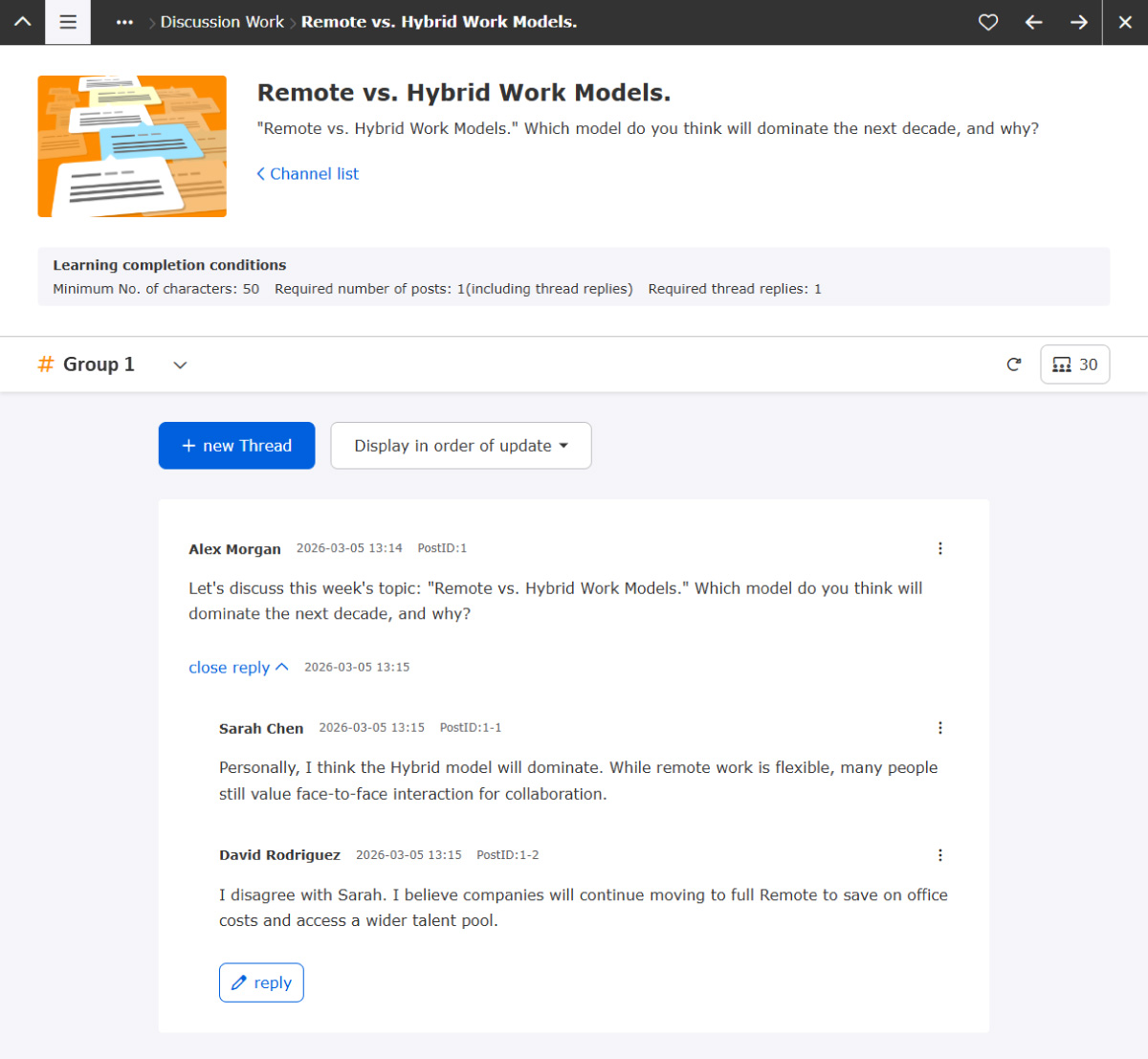
The Discussion feature has been integrated as a distinct content type. This allows the integration of social interaction, understanding others' perspectives , into the traditional cycle of self-study.
1. Enhanced Course Design Flexibility
Instructors can place discussion threads immediately following videos or reading materials. Completing the journey from input to output within a single course significantly boosts knowledge retention.
2. Interactive Learning
By replying to peers, learners move away from the isolation of traditional e-learning. The focus shifts from checking answers to deepening the inquiry.
Use Case
Employee Training:
In New Hire Training or Leadership Development, departments can exchange ideas on specific themes to stimulate cross-organizational knowledge sharing.
School Education:
Serving as a foundation for Inquiry-Based Learning and Active Learning, students can align their understanding online before deepening their workshops during in-person classes.
AI Rubric Auto-Grading: Visualizing Critical Thinking by Criterion

Traditionally, auto-grading in e-learning relied on similarity to a model answer. This update integrates the highly acclaimed Rubrics from the Report assignment feature into the quiz and exam modules.
1.Criterion-Based Scoring
Assignments are scored across multiple dimensions, such as logical structure, appropriateness of expression and application of knowledge. Learners receive instant clarity on their strengths and areas for improvement.
2.Advanced CBT Capabilities
Although quantitatively evaluating logical thinking was previously difficult with multiple-choice tests, the new feature improves the quality of certification exams and internal training.
3.Efficiency and Consistency
The AI automatically generates positive, specific feedback based on the learner’s response. This reduces the workload for educators while maintaining high-quality, motivating instruction.
Use Case
Employee Training:
For sales role-play reports or compliance checks, the system evaluates not just correctness, but whether the learner’s behavior is appropriate for the given situation.
School Education:
AI handles the primary grading for essays and short-answer tests, significantly reducing teacher workloads while providing detailed feedback for every question.
We believe these new features will fundamentally change the nature of e-learning. The "Discussion" feature brings connection to what was once a solitary experience, while AI-driven Rubrics elevate grading from a clerical task to sophisticated, data-driven educational assessment.
By building upon the traditional individual model and providing an environment where learners can cross-pollinate ideas, we continue to support deeper learning and professional growth.


 English
  Japanese